

Frozen shoulder, also known as adhesive capsulitis, is a common condition that causes shoulder pain, stiffness, and difficulty moving the arm. Simple activities such as putting on clothes, reaching overhead, washing your hair, or placing your hand behind your back can become difficult.
For people looking for frozen shoulder treatment, there are several approaches that may help manage pain and gradually improve shoulder movement. Depending on the individual’s symptoms and stage of the condition, treatment may include physiotherapy, gentle shoulder mobilization, massage, stretching, exercise, electrotherapy, ultrasound therapy, and other needle-free treatment options.
At PAPC, treatment can be adjusted according to the patient’s symptoms, shoulder mobility, pain level, and daily activities.
Frozen shoulder is a condition in which the tissues surrounding the shoulder joint become painful and stiff. The medical term is adhesive capsulitis.
The shoulder is a highly mobile joint. It allows the arm to move forward, backward, outward, and overhead. When the joint capsule becomes irritated and tight, normal movement can become increasingly difficult.
Typical symptoms include:
Frozen shoulder does not affect every person in exactly the same way. Some people experience significant pain, while others mainly notice stiffness and restricted movement.
Frozen shoulder is often described in three stages: the freezing stage, frozen stage, and thawing stage.
During the first stage, shoulder pain is often the main problem. Pain may gradually increase and can become particularly uncomfortable at night.
Movement may become more painful, and people may naturally avoid using the shoulder.
During this stage, aggressive stretching or strong mobilization may not be appropriate for everyone. Treatment usually focuses on managing pain while maintaining comfortable movement.
Gentle massage, appropriate physiotherapy, light exercises, and other pain-management approaches may be considered depending on the patient’s condition.
In the frozen stage, pain may become less severe, but shoulder stiffness can become more noticeable.
Patients may have difficulty with:
At this stage, improving shoulder mobility becomes an important part of treatment.
Physiotherapy, joint mobilization, stretching, massage, and active range-of-motion exercises may be used according to the patient’s tolerance.
During the recovery stage, shoulder movement gradually improves. Pain often decreases, and the person may begin to use the arm more normally.
Treatment during this stage can focus on restoring:
Exercise becomes particularly important because stiffness and reduced activity can contribute to muscle weakness.
The recovery time varies significantly between individuals. Frozen shoulder may improve gradually over many months, and some people may experience symptoms for one to two years or longer.
The three stages can overlap, and not everyone follows exactly the same timeline.
Early assessment can help identify the patient’s current limitations and determine an appropriate treatment and exercise plan.
The goal of treatment is not necessarily to force the shoulder to move quickly. Instead, treatment should aim to gradually improve comfortable movement while managing pain.
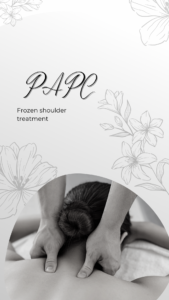
Massage can be used as part of a broader frozen shoulder treatment program.
The purpose of massage is not to directly “break” the stiffness of the shoulder. Instead, appropriate massage may help relax surrounding muscles, improve comfort, and prepare the shoulder for movement and exercise.
Muscles around the shoulder and upper back may become tense when a person protects a painful shoulder.
Massage may therefore be applied to areas such as:
The massage technique and pressure should be adjusted according to the patient’s pain level.
Strong pain is not necessary for effective treatment.
If the shoulder is highly sensitive, aggressive massage may increase discomfort. Gentle techniques may be more appropriate during the painful stage.
During the stiffness stage, massage can be combined with controlled movement and stretching.
The important point is that massage should be part of an overall treatment plan rather than the only treatment for frozen shoulder.
Shoulder mobilization is a physiotherapy technique used to help improve joint movement.
Depending on the patient’s condition, a therapist may use gentle techniques involving:
External rotation is often significantly restricted in frozen shoulder, so improving external rotation may be an important treatment goal.
However, mobilization should be adapted to the patient’s pain and mobility.
A technique that is appropriate for a person in the stiffness stage may not be appropriate for someone experiencing severe acute pain.
Stretching can help maintain or gradually improve shoulder mobility.
Common exercises may include:
The patient leans forward while allowing the affected arm to hang comfortably.
Small movements can be performed forward and backward or in gentle circles.
This exercise is generally intended to encourage comfortable shoulder movement without excessive force.
The affected arm can be assisted by the opposite arm or an exercise tool.
The movement should be performed slowly and within a comfortable range.
The elbow can remain close to the body while the forearm is gently moved outward.
This can help address limitations in external rotation.
A towel can sometimes be used to assist shoulder movement behind the back.
This exercise should be performed carefully because forcing the shoulder into a painful position may aggravate symptoms.
Exercise selection should depend on the individual’s mobility and symptoms.
Electrotherapy may be used as an additional treatment for people with shoulder pain.
Depending on the equipment and treatment plan, electrical stimulation may be used to help manage pain or support muscle activation.
One commonly used approach is TENS (Transcutaneous Electrical Nerve Stimulation).
TENS uses mild electrical stimulation through electrodes placed on the skin.
The purpose is generally pain management rather than directly “unfreezing” the shoulder.
Electrotherapy should therefore be considered as part of a broader treatment program that may include exercise and physiotherapy.
Therapeutic ultrasound may also be used in some physiotherapy settings.
Ultrasound uses sound waves to deliver mechanical energy into tissues. Depending on the treatment approach, it may be used as an adjunct to other physiotherapy techniques.
At PAPC, ultrasound-based treatment may be combined with manual therapy and exercise depending on the patient’s condition.
It is important to understand that ultrasound should not be considered a standalone cure for frozen shoulder. A comprehensive treatment program generally focuses on improving function and movement.
Some patients prefer a needle-free treatment approach.
A needle-free program can include a combination of:
This approach may be useful for patients who do not want acupuncture needles or who prefer to begin with non-invasive treatment methods.
The treatment can be adjusted according to pain, stiffness, shoulder range of motion, and daily activities.
A treatment session can be customized, but a typical example may include:
1. Assessment – 5 to 10 minutes
The therapist checks shoulder movement, pain, stiffness, and functional limitations.
2. Massage – 10 to 15 minutes
Gentle soft-tissue techniques may be applied around the shoulder, upper back, and surrounding muscles.
3. Electrotherapy or Ultrasound – 10 minutes
An appropriate modality may be selected according to the patient’s symptoms and treatment goals.
4. Shoulder Mobilization – 10 to 15 minutes
Gentle joint or scapular mobilization may be performed to support shoulder movement.
5. Exercise – 10 minutes
The patient performs suitable range-of-motion and mobility exercises.
The exact combination should not be the same for every patient. Treatment intensity should be adjusted according to the patient’s response.
Massage may help with muscle tension and comfort, but frozen shoulder involves changes around the shoulder joint capsule and restricted movement.
For this reason, massage alone may not address every aspect of the condition.
A comprehensive approach may combine:
Massage + Mobilization + Exercise + Physiotherapy + Appropriate Electrotherapy
The treatment plan should focus on improving function rather than simply reducing pain temporarily.
Exercise is an important component of frozen shoulder rehabilitation.
When the shoulder remains inactive for a long time, mobility and muscle strength can decrease.
Appropriate exercises may help maintain or improve:
However, more exercise is not always better.
If an exercise causes significant pain or produces a substantial increase in symptoms afterward, the exercise intensity or range may need to be adjusted.
Posture does not necessarily cause frozen shoulder, but poor movement habits and prolonged protective postures may affect how the shoulder and upper back move.
A therapist may therefore assess:
Improving overall movement can help the patient return to normal daily activities.
Shoulder pain should not automatically be assumed to be frozen shoulder.
Other conditions can produce similar symptoms, including:
If shoulder pain begins after a significant injury, if there is severe weakness, deformity, numbness, or rapidly worsening symptoms, professional medical assessment is recommended.
A proper assessment can help determine whether the symptoms are consistent with frozen shoulder or another shoulder condition.
At PAPC, treatment can be adapted according to each patient’s shoulder condition.
For patients who prefer a needle-free approach, treatment may include physiotherapy, massage, shoulder mobilization, therapeutic exercise, electrotherapy, and ultrasound-based treatment.
The purpose is to support pain management, improve shoulder mobility, and help patients return to comfortable daily activities.
Treatment is not necessarily about forcing the shoulder to move. Instead, the goal is to use appropriate techniques at the appropriate stage of recovery.
Frozen shoulder can be frustrating because shoulder pain and stiffness may interfere with sleep, work, exercise, and everyday activities.
However, treatment can be approached gradually.
During the painful stage, the priority may be controlling discomfort and maintaining gentle movement. During the stiffness stage, treatment can focus more on restoring shoulder mobility. During the recovery stage, strengthening and functional exercise become increasingly important.
Massage, physiotherapy, shoulder mobilization, electrotherapy, ultrasound, stretching, and exercise can all be considered as components of a personalized treatment program.
For patients who prefer not to use acupuncture needles, a needle-free frozen shoulder treatment program can combine several non-invasive techniques according to the individual’s condition.
If you have persistent shoulder pain or stiffness, an appropriate assessment can help identify the likely cause and determine which treatment approach may be suitable for you.
© Copyright (C) All Rights Reserved..