

Pickleball is a racket sport enjoyed by people of all ages and skill levels.
Although it is played on a relatively small court, it involves quick changes
of direction, sudden stops, lunging movements, and repetitive strokes,
all of which place various demands on the body.
Players should be particularly mindful of shoulder and elbow pain caused
by overuse, stress on the knees and ankles, lower back discomfort,
and the risk of falls during sudden movements.
Injury prevention starts with maintaining your physical condition,
not just responding when pain occurs.
At PAPC, we assess sports-specific movements and physical condition
to recommend personalized care for each individual.

Moving toward the net and making quick lateral changes of direction
place stress on the knees, ankles, and calf muscles.
The ability to decelerate safely is just as important as acceleration.
Responding to low balls, such as dinks, requires coordinated movement
of the hips, knees, and ankles.
Players should avoid relying solely on bending their lower back.
Repeated movements such as volleys and overhead smashes
can place concentrated stress on the shoulders, elbows, and wrists.
Grip technique and the number of shots performed should also be considered.

Pickleball players should be aware of both acute injuries caused by sudden
movements and overuse-related physical problems.
Rather than identifying the cause based solely on where pain occurs,
it is important to assess movement patterns, training volume,
and overall physical condition.
Gripping the paddle too tightly or repeatedly hitting the ball
using mainly the arm may place excessive stress on the outside of the elbow.
If gripping objects causes pain, symptoms repeatedly return after rest,
or you experience numbness or weakness, a professional assessment is recommended.
Overhead smashes and high shots involve the shoulder joint
and the muscles surrounding the shoulder blade.
Coordination between the shoulder, rib cage, trunk, and hips
is also important.
We assess shoulder range of motion, muscle strength,
stroke technique, and training load to help players
move comfortably without excessive strain.
Responding to low balls and rotating the body during shots
require coordinated movement of the lower back, pelvis, and hips.
Instead of simply rounding the lower back and reaching for the ball,
players should adjust their foot position and use their hips
and knees effectively.
Lunging and changing direction repeatedly place stress on the knees
and ankles. Proper body positioning during deceleration and the ability
to support body weight on one leg are particularly important.
In addition to lower-limb strength, balance, and joint mobility,
footwear and court conditions should also be assessed.
Sprinting and sudden stops generate significant forces
through the calf muscles and Achilles tendon.
If you hear or feel a sudden pop, or experience sharp pain
resembling a kick to the back of your leg during play,
stop immediately and seek prompt medical attention.
Before playing, begin with light activities to warm up your body
and gradually progress to sport-specific movements.
The following is an example of a 12-minute warm-up routine
for adults who are not experiencing pain.
Start with walking and gradually increase to brisk walking.
If comfortable, progress to light jogging.
Avoid starting with maximum-intensity movements.
Perform ankle movements, shallow squats, shoulder circles,
and gentle trunk rotations.
Aim for approximately 6–8 repetitions each,
staying within a pain-free range.
Practice side steps, moving forward a few steps and stopping,
and reacting to movements in different directions.
Prioritize controlled, stable movements over speed.
Start with short dinks, gentle volleys, serves, and returns.
Gradually increase the intensity of your shots.
Important Tips Before Playing
Do not rely solely on prolonged static stretching.
Progress gradually toward actual pickleball movements.
Adjust the routine according to temperature,
fitness level, and physical condition.
Chair squats, calf raises, shallow side lunges,
and single-leg standing near a stable support.
These exercises help develop the strength and stability
needed for sudden stops and lunging movements.
Hip hinges, light resistance-band rows,
shoulder external rotation exercises,
and forearm exercises.
These activities help promote coordinated body movements
rather than relying only on the arms.
We assess standing posture, joint range of motion,
foot condition, and movement patterns
to better understand the physical demands placed on the body.
We recommend exercises based on individual physical needs,
including lower-limb stability and coordination
between the shoulders and core.
We assess foot structure, weight distribution,
standing posture, and walking patterns,
and consider customized insoles when appropriate.
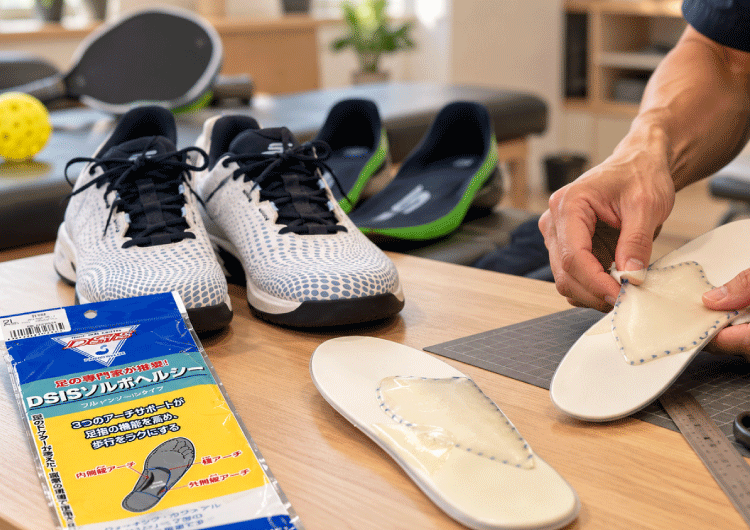
At PAPC, we have provided Dr.DYMOCO custom-made orthotic insoles
for a pickleball player.
Pickleball involves frequent short-distance movements,
lateral changes of direction, and lunging,
all of which place various demands on the feet.
When considering orthotic insoles, it is important
to assess not only foot condition but also standing posture,
body movements, and the shoes used during play.
Dr.DYMOCO Custom-Made Orthotic Insoles
Based on a physical assessment, we consider custom-made insoles
suited to the individual’s foot condition and movement patterns.
Insoles are not necessary for everyone, and recommendations
are made according to individual assessment results.
From pre-game preparation and injury prevention to physical care
and tournament-day condition management.
We offer a free conditioning guide to help players
enjoy pickleball safely for years to come.

Japanese Edition / 23 Pages
No Registration Required / Free Access
About This Guide
This booklet is a general educational resource
adapted to the characteristics of pickleball,
based on athletic training materials,
sports medicine references, and other relevant resources.
It is not intended to provide individual diagnosis or treatment.
First, reduce the shots or practice activities that cause pain.
If the pain continues or occurs even when gripping objects,
we recommend an assessment by a healthcare professional.
Start with walking or other light activities to warm up your body.
Gradually progress through joint mobility exercises,
footwork drills, and gentle hitting.
Detailed instructions are also available in our free PDF guide.
No. Orthotic insoles are not necessary for everyone.
Their suitability should be determined after assessing
foot condition, overall body movement, footwear,
and sport-specific movements.
Yes. At PAPC, we also provide consultations and physical assessments
for injury prevention and general conditioning,
even for individuals who are not currently experiencing pain.
Whether you are experiencing shoulder, elbow, lower back,
or knee discomfort, or would like to improve your body mechanics
and foot stability, our team is here to help you
with your pickleball-related physical concerns.
Phnom Penh Acupuncture & Physiotherapy Center (PAPC)
© Copyright (C) All Rights Reserved..