

Declining eyesight has become increasingly common in Japan and is sometimes regarded as a modern lifestyle-related issue. In particular, vision problems among children are increasing rapidly. The widespread use of smartphones, video games, and other digital devices is considered one of the contributing factors.
According to a survey by Japan’s Ministry of Education, Culture, Sports, Science and Technology, 42.38% of junior high school students have visual acuity below 0.7, meaning that more than two in five students may require some form of vision correction.
It is also estimated that approximately 70% of people in Japan use corrective devices such as glasses or contact lenses.
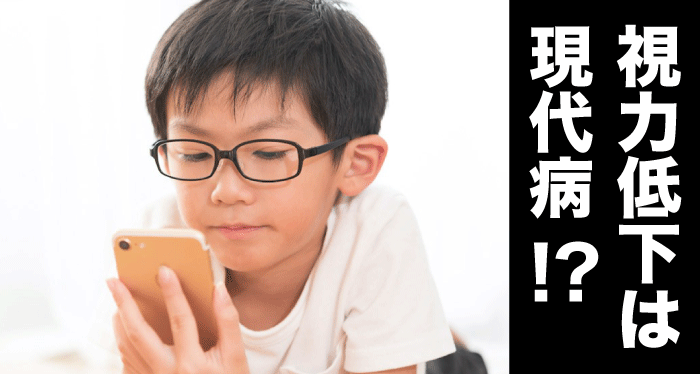
Why are vision problems so common in Japan?
There are generally five major factors that may contribute to declining eyesight.
Spending long periods looking at objects at close range is one of the major factors that places stress on the eyes.
When looking closely at something, people may squint or stare intensely in an attempt to focus more clearly.
This can place excessive strain on the eyes and contribute to eye fatigue.
Looking at smartphones or other objects while lying down, or using a smartphone or playing games while performing other tasks, may cause one eye to work harder than the other.
This can create differences in visual acuity between the two eyes.
When one eye becomes dominant, additional strain may be placed on that eye, potentially contributing to further vision problems.
Smartphone and computer screens emit light directly.
Looking at bright screens for long periods can place additional strain on the visual system and contribute to eye fatigue.
Blue light from digital devices may also increase visual strain, particularly when screens are viewed for long periods in dark environments.
The eyes continuously attempt to adjust to differences in brightness, which can contribute to significant eye fatigue.
Nutritional deficiencies may also affect eye health.
An unbalanced diet may result in insufficient intake of nutrients such as vitamin A and vitamins B1 and B12, which are important for normal eye and nerve function.
Vitamin B1, in particular, plays an important role in nerve function.
Maintaining a balanced diet is therefore important for supporting overall eye health.
The eyes and brain are closely connected through the nervous system.
Strong psychological stress may affect the autonomic nervous system and increase tension throughout the body.
Physical stress may also contribute to reduced circulation and increased tension in muscles involved in eye movement and focusing, including the ciliary muscles.
These factors can make it easier for vision-related problems to develop in modern Japanese lifestyles.
There are also several common misconceptions in Japan regarding eyesight and eye care.
Amblyopia is a condition in which adequate visual acuity cannot be achieved even with glasses or contact lenses.
A newborn baby’s vision is normally still developing and is initially quite blurry. Visual acuity is approximately 0.1 at around one year of age.
As children grow and continue to look at objects around them, visual stimulation reaches the retina and the visual system gradually develops, eventually reaching a visual acuity of approximately 1.0 or higher.
However, if something interferes with this developmental process, normal visual development may be disrupted, resulting in amblyopia.
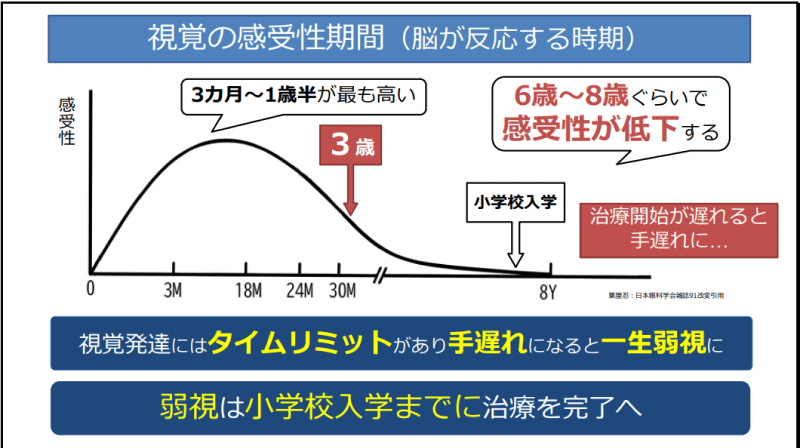
Visual development has a limited period during which the visual system is particularly responsive to stimulation.
Visual sensitivity is generally considered to be especially high during early childhood, particularly until around 18 months of age.
Sensitivity gradually decreases thereafter, with the period up to approximately 8 to 10 years of age considered particularly important for visual development.
After this period, improving visual function may become more difficult.
In Japan, people commonly visit an ophthalmologist when their eyesight worsens.
Ophthalmology primarily focuses on diagnosing and treating diseases and abnormalities of the eyes, while vision correction and visual rehabilitation may require different approaches depending on the underlying cause.
Approaches to vision care differ from country to country, and various forms of visual rehabilitation and vision training are used depending on the condition and individual needs.
At our clinic, before beginning vision training, we first evaluate and address the condition of the eyes as well as the overall balance of the body.
This is similar to the way athletes prepare and condition their bodies before competition, as overall physical balance can influence performance.
Tight or stiff muscles can reduce movement efficiency and increase physical strain.
By addressing the condition of the whole body, we aim to support circulation and improve overall physical function.
Visual function is closely related to the muscles involved in eye movement and focusing.
These muscles can generally be divided into intraocular muscles located inside the eye and extraocular muscles located around the outside of the eyeball.
The intraocular muscles help control functions such as pupil size and focusing.
The extraocular muscles move the eyeballs in different directions and are used repeatedly throughout the day.
Modern lifestyles often involve prolonged near-focus activities such as using computers and smartphones.
As a result, the muscles involved in eye movement and focusing may become tense or fatigued.
When muscle tension increases, circulation and oxygen delivery may be affected, potentially contributing to eye fatigue and visual discomfort.
At our clinic, nationally licensed practitioners provide care aimed at reducing excessive muscle tension around the eyes and supporting circulation.
Through this approach, we aim to support better visual function and reduce eye fatigue.
Vision training is designed to improve visual functions — the ability of the eyes and brain to effectively process visual information.
By training eye movements and visual coordination, vision training aims to improve the ability to accurately track and focus on objects using both eyes.
It also helps develop the process of receiving visual information, processing it in the brain, and translating that information into appropriate body movements.
Four Types of Vision Training Offered by Medical Japan
These exercises can also be performed easily on your own.
At our clinic, we evaluate each patient’s condition and recommend an appropriate approach based on their individual needs.
Please feel free to consult with us.
The ES-530 is an electrical stimulation therapy device manufactured by Ito Co., Ltd., a leading Japanese manufacturer of physical therapy equipment.
It is used in a wide range of rehabilitation and sports-care settings, including the care of elite athletes.
The device provides several types of electrical stimulation, including three-dimensional medium-frequency stimulation, high-voltage stimulation, and microcurrent stimulation.
Multiple treatment modes can be selected depending on the individual’s condition and treatment goals.
The three-dimensional dynamic interferential current therapy used at our clinic generates three different medium-frequency electrical currents from different directions within a three-dimensional space.
These currents interfere with one another and create a dynamic three-dimensional stimulation pattern.
This allows stimulation to be delivered across a relatively broad and deep area.
The therapy is used as part of physical rehabilitation to support muscle and nerve function, circulation, pain management, and muscle conditioning.
We provide individualized treatment using a combination of gentle manual therapy, acupuncture based on traditional East Asian medicine and meridian points, and physical therapy using advanced equipment such as the ES-530 manufactured by Ito Co., Ltd.
By improving the condition of the muscles involved in eye movement and focusing, we prepare patients for vision training and provide guidance on exercises that can also be performed at home.
Our treatment and training programs are designed to support individuals with various visual concerns, including myopia, hyperopia, amblyopia, astigmatism, and presbyopia.
© Copyright (C) All Rights Reserved..