

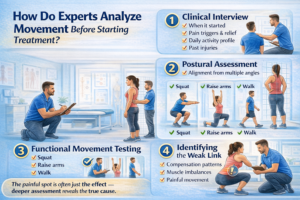
Before any hands-on therapy begins, skilled look beyond the pain site. Movement analysis helps uncover why pain developed — not just where it hurts.
Here’s how experts typically approach it:
Before observing movement, professionals gather context:
-When did the pain start?
-What movements trigger it?
-What relieves it?
-Work habits, exercise routines, stress levels
-Previous injuries or treatments
Pain rarely appears randomly. It usually reflects a breakdown in load management, movement quality, or recovery.
Even when standing still, the body reveals patterns:
-Forward head posture
-Rounded shoulders
-Pelvic tilt
-Uneven weight distribution
-Spinal asymmetry
Static posture often predicts how the body will move dynamically.
Experts observe how you:
-Squat
-Bend forward
-Rotate your spine
-Raise your arms
-Walk
They look for:
-Compensation patterns
-Muscle imbalances
-Joint restrictions
-Instability
-Painful arcs of motion
Pain is often the result of compensation , not weakness alone.
One key question:
Is the problem caused by stiffness — or by instability?
-Tight hip flexors may limit movement
-Weak glutes may overload the lower back
-Restricted thoracic spine may strain the neck
Experts determine whether to release, strengthen, or re-educate.
Sometimes the issue is not strength — it’s timing.
Professionals assess:
-Core activation patterns
-Scapular control
-Deep stabilizer engagement
-Neuromuscular coordination
This reveals whether the nervous system is properly controlling movement.
Treatment planning requires knowing:
-How much load your body can tolerate
-Whether your daily habits exceed that threshold
-How quickly tissues recover
Pain often develops when load exceeds capacity repeatedly.
The painful area is often compensating for something else.
Example:
-Neck pain caused by thoracic stiffness
-Knee pain caused by hip weakness
-Back pain caused by poor breathing mechanics
Experts trace movement chains to find the true driver.
Only after assessment do professionals decide:
-What to release
-What to activate
-What to stabilize
-What to retrain
-What lifestyle changes are required
Without this analysis, treatment risks becoming temporary relief instead of long-term correction.
If pain keeps returning, it’s often because:
-The root cause wasn’t identified
-Movement patterns weren’t corrected
-Stabilization wasn’t restored
True recovery begins with understanding how your body moves — not just where it hurts.
© Copyright (C) All Rights Reserved..